
Prospero Riva official
 INSIEME - ENSEMBLE |  CARRIOLANTI - WHEELBARROWS |  GIOCATORI DI BILIARDO - BILLIARDS PLAYERS |
|---|---|---|
 PESCATORI - FISHERMEN |  PAESAGGIO ARANCIONE - ORANGE LANDSCAPE |  CASE - HOUSES |
 LA SIGNORA - THE LADY | 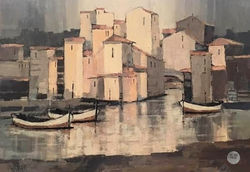 PAESAGGIO LACUSTRE - LAKE LANDSCAPE |  LA BAMBINA CON L'ANGURIA - THE LITTLE GIRL WITH THE WATERMELON |
 LE NOTIZIE SUL GIORNALE - THE NEWS ON THE NEWSPAPER |  MIGRANTI - MIGRANTS | 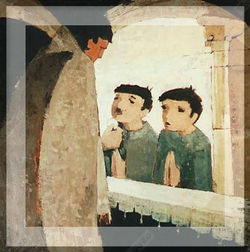 LA COMUNIONE - THE COMMUNION |
 LA NEVICATA - THE SNOW |  IL PARROCO DI CAMPAGNA - THE COUNTRY PARISH PRIEST | 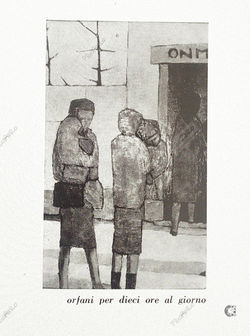 ORFANI PER 10 ORE AL GIORNO - ORPHANS FOR 10 HOURS A DAY |
 CASE POPOLARI - PUBLIC HOUSING | 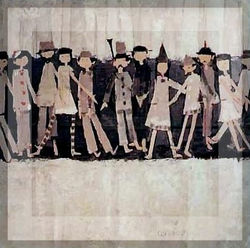 MARIONETTE - PUPPETS |  PAESAGGIO - LANDSCAPE |
 LAVORATORI - WORKERS |  PARTENZA - DEPARTURE |
Prospero's artistic career was very long and his style had a constant evolution over time, while the themes covered were often influenced by social and personal events, the greatest evolution occurred when he began to paint figures as well as landscapes. A newspaper page from the 1960s defines him as: THE LANDSCAPE ARTIST OF MILAN, because his art was dedicated to the landscapes of the Milan suburbs, but also to small towns he lived in when he was displaced in Caldana during the war. Later he wanted to paint figures, characters dedicated to more or less delicate topics, both experienced on a personal and social level. Certainly much of what he brought onto canvas was what was in his heart.
He was a very intelligent, humble and very empathetic person so he could understand the mood of the figures he painted. This is why his characters often had sad and serious faces. However, in his life Prospero was a cheerful person, always ready to joke. With his wife Anna they formed a very friendly couple, but often what you see is not what people carry inside them. And this is precisely what can be perceived in his works.
Thus he paints workers in struggle, workers of the land, insists on the theme of poverty. He doesn't see well the construction of factories that erase the beautiful, hard-worked fields. Another topic he is sensitive to is that of mothers and children. Thus he represents the tenderness of these mothers, he is saddened by children forced to stay in nursery school for several hours a day, and then he shows us the family in different situations: migrants leaving in search of work, during a simple walk, but then he takes umbrage at the issue of separation and paints a picture titled: NO! in which a little girl tries to reunite her parents, and shows us the loneliness of a mother and a little girl left alone. His works are increasingly closer to what he sees close to him and he lives with bitterness.
Meanwhile his technique changes and during the 70s his line became more geometric. It brings attention to sometimes forgotten people, but also objects that are not particularly important, thus creating works such as: Clothespins, Stove Pipes, Fish Bones, the Violin, the Cabins on a Beach, the Wagons of a Train, because everything it matters in his eyes.
Masks are another type of subject he prefers, we find many paintings by Pierrot, dancers and Harlequins with studied colours, but he is also fascinated by other well-known figures such as Don Quixote, to whom he dedicates more than one painting, or the Templars to whose story he is particularly interested. He never stops painting landscapes and in particular creates the work: Santa Caterina del Sasso, which is an ancient monastery located on Lake Maggiore. Then there is a period in which he approaches religion and gives us many paintings of the Madonna and Jesus. He wants to show the latter's suffering, not on the cross as it is too often represented, but during the journey to Golgotha, as he is crowned, as he is deposed, and for the Last Supper, which we talked about earlier.
At a certain moment in his life, Prospero makes a vow to Pope John XXIII to whom he was close when he was alive, so he paints a portrait of him and reproduces the drawing of this portrait several times, to give it to all the people around him. Another religious figure to whom he dedicates himself is Padre Pio, while still remaining on the subject of portraits, he finely reproduces the face of Giuseppe Verdi and gives a personal face to Hamlet.
His art shifts between what his fantasy gives him to what actually existed. In the meantime his technique evolves and he begins to create increasingly studied backgrounds, while filling pages with sketches for works that he wants to put on canvas. He also decides to create a collection of drawings, one of which represents the stages of the Via Crucis and of the Via Crucis he creates an altarpiece where he brings together all the stages (the one at the end of this page). After the year 2000 the Master began to portray subjects in a slightly more abstract way, so we find beautiful paintings in which on one canvas he brings together a landscape and a still life, or two moments of life or a postcard motif. We can find them on this site: Moments, Autumn, Postcard and others, it also gives us particular landscapes with brighter colors such as orange. It seems as if he had found a sort of serenity, from his notes we understand that he had no intention of stopping, but that the loss of his wife Anna, who left 5 years before him, became increasingly stronger, until he decided to join her. He also leaves us some unfinished paintings...
Above all, he left us a great void, both of them did, and the lives of their children and grandchildren have changed completely.
We thank them for everything they have done for us and for many people.
The granddaughter wants to share
a memory with great nostalgia:
<I remember my grandfather
wanted to help me express my love for art:
as soon as I came back from school,
if I didn't have homework, he gave me paper
and pencil to draw what I wanted.
I often tried to copy his paintings.
In the end I was rewarded with the opportunity
to display my drawings throughout the living room,
which was transformed into a small makeshift gallery.
They were very beautiful moments for me, I was so small but
I felt important. More beautiful moments
with my grandfather, she says, were when
I stood next to him with my little easel
while he painted, and I "painted" too>.
So the story of Uncle Antonio,
which you can read on the last page,
repeats itself and a part of his family
inherited this "artistic streak".
We were not able to include everything that Prospero made during his artistic career, for example all the collective exhibitions in which he participated are missing, but this will be a "dynamic" site and will be updated periodically to include other paintings or material which will be made available.
This was the beautiful artistic career of a great man.




ART IS THE LANGUAGE OF LOVE,
LOVE IS A UNIVERSAL PRESENCE
THE VIA CRUCIS

This painting represents the Via Crucis. The Via Crucis is the subdivision into stages of the journey of agony that Jesus made up to Golgotha. Generally these moments are represented with separate tables, in front of which the believer stops, remembers the moment and prays. However, all this made us forget that Jesus did not want to leave a memory of suffering and death, but on the contrary he came to celebrate the life and love that everyone should have towards their brothers and sisters. Prospero brings together all the stages in a single altarpiece in front of which we can stop and remember that since man has struck with his violence, we should now understand the true message that Jesus wanted to convey: love and compassion and not forgiveness of sins.